Friday, December 10, 2010

In Conclusion

I think I've at least met my personal goals with this project. It got me off my lazy bum to recycle. The blog made me accountable for my actions in a public space. It encouraged me to clean, complete my goals of recycling, and research more about why we should recycle. I don't know if it convinced you, the reader, but I hope you at least learned something or enjoyed my exploits. This is a final car load of junk that has been sitting my car for a while. It's got to go:


Compared with using materials only once then discarding and replacing them, recycling saves energy, reduces pollution from manufacturing and transportation, and avoids destroying mateirals and natural resources. Please join me in my quest to recycle, UNL. If I can do it, so can you. Thanks for reading.

Denison, Richard A. and John F. Ruston. "Anti-Recycling Myths." Environmental Defense. 18 July 1996. Web. 10 December 2010.

The Mess is Clean

After much procrastinating I have finally cleaned up my apartment. I got rid of my junk corner and the beer wall, as well as other stuff sitting around the place. Observe before and after photos below:


It's off to Russ's with all this stuff. I'm finally fulfilling my goal and de-junking my life.

Thursday, December 9, 2010

Beer Wall Full!


Now that the beer wall is full it's time to take it all to my recycling center of choice at Russ's Market. I have always had a soft spot for it, at least compared with Super Saver. Jake will be sad to see it go but I think he'll manage. Lee will get to start his juice wall.

Wednesday, December 8, 2010

Recycling on Campus

UNL actually is a pretty good campus as far as recycling is concerned. When I started as a freshman, I don't remember recycling containers being as ubiquitous as trash cans. Maybe my memory is fuzzy or maybe there just weren't as many. Anywho, I see recycling containers just about everywhere there are trash cans now. In buildings, outside, here there and everywhere there are recycling containers. This is the first one I see on my daily jaunt to class:

The most common recycling bins at UNL appear to be plastic, cans and newspapers. The usual suspects. If I know there is a recycling station coming up, sometimes I'll go out of my way to reach it. Sometimes I don't. I need to work on that.

In a slightly related note, but not really, The Academic Grind offers $.70 coffee if you are refilling. The same price goes for using a tumbler. That's a pretty cheap cup of coffee nowadays. Compare your 16-20 oz tumbler refill for $.70 to a 12 oz tall coffee at Starbucks for $1.50.

That reminds me this semester of when free coffee was offered outside the union for anyone with a reusable container. That was an awesome day. Free coffee and saving the environment? Check.

I'm rambling again. Back to UNL's recycling opportunities. In 2009, the entire UNL campus collected 2984.42 tons of recyclables. Nice! Here are some quick figures from the UNL Recycling Website:

In 2009 UNL recycled 44.3% of its waste, up from 9.3% from 2008.

National average of waste that campuses recycle per year - 26%.

So far UNL has saved:

  • 3,543..... Cubic yards of Landfill Space
  • 18,251..... Trees
  • 64,417..... Eliminated pounds of Air Pollution
  • 4,401,801..... KW Hours of Electricity
  • 7,515,270..... Gallons of Water
"UNL - Recycling." University of Nebraska - Lincoln. n.d. Web. 8 December 2010.

Tuesday, December 7, 2010

Billie Jean

A great program that recently occurred on the UNL campus was the denim drive. A collection box was set up in the City Union for students to toss in their old jeans where they would in turn be recycled into material to insulate homes. The program was sponsored by the Public Relations Student Society of America at UNL and Cotton Incorporated, a research and marketing company.. It was part of a national campaign called "Cotton. From Blue to Green."

The response was overwhelming and the campaign received well over its goal of 500 pairs of jeans. I meant to donate some of my old, ripped ones but unfortunately the campaign was over before I got the chance.


Buckley, Kim. "UNL denim drive aims to help insulate homes." Daily Nebraskan. 4 Monday 2010. Web. 6 December 2010.

Sunday, December 5, 2010

Arguments for Recycling Part I

Maybe this blog is inspiring those of you already sold on recycling, or maybe not. Maybe it's changing minds of those previously not on the band wagon, or maybe not. But I feel like I should present some arguments for those of you not initiated. I found a great article "Anti-Recycling Myths" by Dr. Richard A. Denison in response to a "Recycling is Garbage" by John Tierney from New York Times Magazine, June 30, 1996. Dr. Denison combats some of the most common arguments against recycling. At it's most broad, it claims that it is not a money making scheme created by hippies. I will present arguments against recycling followed by a response below.

-The modern recycling movement is result of the fake crisis about landfill space, concocted by the media and liberal environmentalists.
-Focusing on landfill space misses the point entirely. The biggest environmental rewards of recycling come from reducing natural resource usage, damage and pollution that arise when extracting virgin material and producing new products. Materials that are collected for recycling have already been extracted and processed once, so processing the material again is usually much less energy demanding than the first.

-Landfill space is cheap and plentiful.
-Landwill space is a commodity, priced according to supply and demand. The biggest growth in recycling programs in the United States has been in regions where landfill space is expensive compared to the U.S. average.

-Recycling should pay for itself.
-Landfills and incinerators do not pay for themselves, and we shouldn't expect this of recycling either. We should not focus on start up costs of recycling programs but rather look at it overtime. Recycling programs are becoming more competitively priced with disposal options.

Denison, Richard A. and John F. Ruston. "Anti-Recycling Myths." Environmental Defense. 18 July 1996. Web. 5 December 2010.

Saturday, December 4, 2010

The Pile Expands

As I mentioned yesterday, my pile of stuff is growing rapidly. Now that I've found my closest recycling sites, I need to throw all this stuff in the car and head out. Overcoming my own apathy towards recycling is one of my main reasons for starting this blog. By holding myself accountable in a public forum, I hope to inspire myself to action.

Friday, December 3, 2010

Lincoln Recycling Sites

I found them.


It looks my two most convenient spots are 20 and 22. Ironically, my two closest recycling sites sites are at rivaling grocery stores: Russ's Market at 33rd & Highway 2 and Super Saver at 27th & Pine Lake Road. Where's Hy-Vee's recycling site? Although Hy-Vee has done its fair share of sustainability work.

Hy-Vee recently opened a new location in a new state. The Madison, Wisconsin store is designed to attain LEED certification (Leadership in Energy and Environmental Design). LEED is the nationally accepted standard for the design, construction and operation of green buildings.

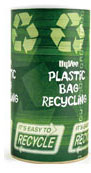
All Hy-Vees, or at least all the locations I have been in, also have plastic bag recycling available in these handy green bins right by the entrance:


Looks like I've got a drop off of plastic bags to make. Not all of my plastic bags can fit into my dispenser. I've also got to take all the crap that has been piling up in my corner to recycling. It's getting pretty bad.

"InterLinc: Recycling Drop-Off Sites." InterLinc: City of Lincoln & Lancaster County. n.d. Web. 3 December 2010.
"Sustainability Efforts." Hy-Vee. n.d. Web. 3 December 2010.

Thursday, December 2, 2010

Bags Part II

Thought we were done talking about bags? Think again.

I took my own advice from yesterday and put my reusable bags in my car. At least I grabbed the ones I could find. I'm missing my official Hy-Vee sanctioned bags that I bought. My free ones from KFRX and Super Scoopers will do. I got the latter bag about four years ago if my memory serves me correctly, way before they were popular.

What about all the plastic bags that I end up taking home with me? Are they destined to spend eternity rotting in some landfill? Well, yeah but at least I'll reuse them again. Observe:

When I was buying household items for my new apartment, I ended up with this plastic bag holder/dispenser. You place bags in the top and pull them out the bottom. They're great for lining small trash cans or wrapping up lunches to take to school. Taking lunch to school is also a good and green option for the broke college student such as myself. It's usually way cheaper to bring something from home than buying fast food. And with fast food, you will likely throw away the burger wrapper, fry box, drink cup, lid, straw, straw wrapper, tray liner, ketchup packets, and napkins. Those are a lot of items ending up at the dump.

I digress again. Here's another shot of my killer bag dispenser:


Many customers I encounter at Hy-Vee say they prefer paper sacks for their recycling. Newspapers fit in them well and can be recycled on the spot. That reminds me, I need to actually find my closest recycling site. Stay tuned for that.

Since I mentioned waste associated with fast food, it made me think of food containers in general. Consider this:

  • For every $11 Americans spend on food, $1 goes to packaging.
  • Americans throw away the equivalent of more than 21 million shopping bags full of food into dumps each year

"Recycling facts." Oberlin College Resource Conservation Team. 2001. Web. 2 December 2010.

Wednesday, December 1, 2010

Bags

As much as I hate grocery shopping, I had to go tonight. Running out of food, I got in my car and headed down to Hy-Vee. I live about two minutes from one of the Hy-Vees, yet work at one about 25 minutes away. If I really wanted to live a greener life and shed some fuel emissions, I guess I should transfer. Grocery shopping is something I don't enjoy surely because of my tenure at Hy-Vee. I spend enough hours in a grocery store every week. I digress.

Anyway, I need food. I'm out of anything remotely edible. I park my car, brave the biting wind and reach the front doors. Only then do I realize I do not have my reusable bags in hand. Do I go back to the car or take plastic sacks at the check out? Thinking specifically of this blog, I turn around and head to my car for my reusable bags. Pop open the trunk. Nothing. Check the back seat. Nada. Where are my reusable bags? They must be at home. Great.

Working at a grocery store, I handle a lot of bags. When I started way back in February 2008 most customers took plastic bags at the check outs. Those who preferred paper were usually either elderly people or younger, health conscious yuppies. Reusable bags were not very common. Now they are prevalent, maybe in part because they have gone down in price. Reusable bags are sometimes giveaways which makes them more tempting than shelling out $1.

At work last week one of managers, Matt, was making small talk with a customer. The customer causally asked how many people brought in reusable bags and Matt estimated that about a third do. This answer surprised me but as I thought about it, that figure seemed in the ballpark. When I first started at Hy-Vee, I remember thinking most of the customers who brought their own bags were kind of freaky. Especially those who brought in their ten-year-old gunny sacks that smelt of ass. But now BYOB (Bring Your Own Bag) is widely accepted. There are shelves of reusable bags for sale at each check out at my Hy-Vee.

And the whole paper vs. plastic debate could be a project of its own, but it reminds me of a figure I read in our Hy-Vee company magazine. I wish I could find it but I remember it said that the plastic bags are actually more eco-friendly than paper bags. The energy required to produce paper bags, from gathering the material and physical production, is greater than that required to make plastic bags. While both kinds of bags can be recycled, of course paper bags come from trees. Plastic bags come from oil. Still, it's interesting that plastic bags are more eco-friendly. I'd like to tell those hippies who prefer paper but they'd never believe me. I wish I still had that magazine. I will look up real facts and figures soon, I promise.

So where was I? I got off on several tangents. Oh right, tomorrow I should put my reusable bags in my car. And avoid another shopping trip.

Tuesday, November 30, 2010

Too Much Beer


My roommate Jake and I are filling up our "beer wall." We have to place a new bottle on the wall for every new kind of beer we try. Our other roommate doesn't drink and hates looking at it. He wants to start a "juice wall." Jake and I really should slow down though. Each of those bottles came from a six or twelve pack. That doesn't include repeats. Here's a close up to better see the brands:

While Jake and I get fat and stupid from drinking all this beer here are some interesting facts on recycling glass bottles I found from Oberlin College:
  • Glass doesn't wear out; it can be recycled indefinitely. For every ton of glass recycled, over a ton of resources are saved: 1,330 pounds of sand, 433 pounds of soda ash, 433 pounds of limestone, and 151 pounds of feldspar.
  • Most bottles and jars contain at least 25% recycled glass.
  • States with bottle deposit laws have 35-40% less litter by volume.
  • Americans toss out enough glass bottles and jars every two weeks to fill up the 1.350-foot towers of the former World Trade Center.
  • If all glass bottles and jars recycled in the U.S. in 1994 were laid end to end, they'd stretch to the moon and half way back to earth.
As sophomorically cool as the beer wall appears, it is kind of juvenile. I think once we fill up the wall, we should take everything down to recycling. We'll see.

"Recycling facts." Oberlin College Resource Conservation Team. 2001. Web. 20 November 2010.

Sunday, November 21, 2010

Welcome to Recycle UNL

Hello UNL.

This is the inaugural entry in what will hopefully be a regularly occurring blog. So what's the purpose? Why should you be reading this? The goal for this blog is to get everyone reading it to recycle. We all need to recycle anything recycle-able. We'll start small. Newspapers, cans, bottles aren't so bad. Composting sounds unappealing. We'll work our ways up to that.

Maybe I'm getting ahead of myself. Does this sound like too much work? It does to me too. But we all have to start recycling if we want to keep our planet livable and sustainable. I firmly believe that someday everyone will recycle nearly everything that we currently throw away. Boxes, wrappers, linings, every kind of container will be recycled. And items that aren't recyclable now will be made that way in the future. I'm just not sure how long it will take to get there. But we all have to start sometime. Let's start sooner rather than later.

Why recycle now? Why does anyone really need to recycle? Why blog about it? The inception comes out of my own laziness and guilt for not recycling. I know I should recycle but I haven't been able to make myself actually do it. When I lived at my parent's house recycling was easy for me. All I had to do was throw my bottle, can, or container into a paper bag and my parents did the rest. They made regular trips to the recycling center and sorted everything for me. When I moved into my own apartment, I vowed to continue their fine example.

I got lazy. I meant to get real recycling containers. Not to diminish paper bags, but they look rather boring. I wanted real containers labeled "glass," "aluminum," and "plastic." I thought that would make me feel all official. Instead, I have this pile of crap sitting in my laundry room corner:

I have no sorting method at all. I just throw stuff in the corner, mostly space consuming cardboard, and hope that I'll get around to recycling it.

My first step toward becoming a good-little recycler is to take all of the crap out of the corner and actually recycling it. Maybe my next step is to get official containers. Maybe that will inspire me. I'll update this blog with research and figures eventually. This is a horrible preliminary post but things will get more coherent with revision, I promise.


So, what will Recycle UNL be exactly? This is going to be a blog that invites you the reader, the fellow UNL student, to recycle. I'll try to get off my own lazy ass and be a good example. It's not a foreign, scary concept. But maybe it is hard to get over our apathy towards it. Let's recycle. We're all in this together.